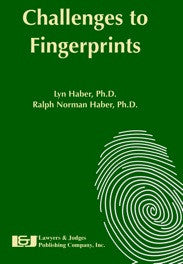
If you have occasion to qualify or cross-examine expert fingerprint witnesses, Challenges to Fingerprints is a useful and instructive practical addition to your bookshelf. The authors--professionals with positions at top academic institutions--have conducted trainings for organizations including the Innocence Project and have published peer-reviewed articles on fingerprint science. Ralph and Lyn Haber are not mere iconoclasts looking to tear down the science of fingerprint analysis. They do not question its usefulness and validity when conducted by qualified, experienced personnel in accord with proper procedural safeguards to reduce or eliminate the possibility of error. They offer constructive criticism that, if followed, could improve the field. Illustrations help readers understand the fundamental principles of this forensic science. The authors clearly distinguish easy cases from difficult ones. They identify problems concerning distortions and partial prints. Citing many professional studies, the book contains extended coverage regarding problems in qualification standards for both examiners and laboratories. It deals with bias effects in the reliability of verification procedures as well as with accuracy issues and problems in proficiency and certification testing, its administration, and quality control. One troublesome illustrative example is the administrative failure in permitting take-home and collaboration on individual proficiency testing. Another is the failure to use blind confirmation analysis tests. Chapters seven and eight provide a valuable explanation essential to understanding confusion generated about error rates, especially by people with limited mathematical understanding, which can lead to unscientific exaggerations and claims characterizing methods as incapable of producing erroneous results. Today, many television shows frequently feature automated fingerprint identification systems (AFIS). Law enforcement investigators on these shows are regularly dramatically shown making "cold hits," which means they have a latent print and no suspect, but later find a suspect by searching a fingerprint database. The authors demonstrate how in fact the use of AFIS is extremely more complicated than implied in television dramas. Too many factors can affect AFIS search accuracy. The prints in the comparison database must be of good quality, and the size of the database can make a significant difference. The crime scene latent may be partial, smudged, and its direction difficult to determine. Moreover, there are no uniform algorithms used in the definition of print similarity. A large difference in identifications depends on whether the search is required to return only one match or a possible pool of candidates. Finally, there are no current standards governing the training and proficiency of AFIS technicians. This 217-page book is a great primer. It helps to focus on the current weaknesses in methods and practices; cogently articulates the issues; and raises questions relevant to establishing whether expert testimony claiming fingerprint identification is reliable, admissible, and probative. Any vague, backhanded dismissal of this work--without clear responses to the many well-documented questions raised--does a disserve both to justice and professionalism. There is simply no comparable practice manual in the field available that offers both a useful basic understanding and critical analysis that enable probing voir dire and cross-examination of fingerprint analysis expert witnesses. For anyone involved in cases that include this type of evidence, Challenges to Fingerprints is a valuable acquisition.