Lawyers & Judges Publishing Company, Inc.
Cart 0
Principles of Forensic Human Factors/Ergonomics - Lawyers & Judges Publishing Company, Inc.

Principles of Forensic Human Factors/Ergonomics

$ 49.00

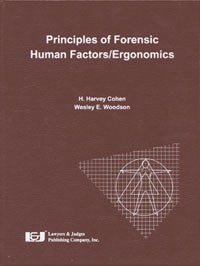
Principles of Forensic Human Factors/Ergonomics by Wesley E. Woodson and H. Harvey Cohen is an essential reference for attorneys, engineers, and safety professionals working in personal injury and products liability cases. This 275-page hardcover (revised edition of Human Factors Engineering for Forensic and Safety Specialists) takes you step-by-step through human factors issues in architecture, transportation, consumer products, equipment, and tools.

  • Authors: Wesley E. Woodson, H. Harvey Cohen
  • ISBN-10: 1-933264-09-8
  • ISBN-13: 978-1-933264-09-7
  • Copyright: July 8, 2005
  • Pages: 275
  • Binding: Hardcover
  • Size: 8.5 x 11 inches

Topics Include:

  • Design-induced human error and product misuse
  • User/product interface — falls, obstructions, visual limitations, and sensory-motor factors
  • User limiting characteristics — body dimensions, physiologic factors, and hidden safety booby traps
  • Architectural systems — site selection, facility planning, and accident minimization through design
  • Vehicular and roadway systems — automotive design failures, ingress/egress, service hazards, aircraft, and agricultural/construction equipment
  • Consumer products and tools — large and small appliances, tools, and toys
  • Home and work furnishings — chairs, tables, counters, and workplace configurations
  • Graphics — product labeling principles
  • Human factors/ergonomics testing methodology for architecture, automotive, aircraft, roadway, and consumer products

Customer Reviews

Based on 2 reviews
100%
(2)
0%
(0)
0%
(0)
0%
(0)
0%
(0)
R
Ross Eddie, P. Eng.
Canada Society of Forensic Science Journal

The introduction of this book declares an intent to give a better understanding of what and how human factors relate to the safety of machines, products, systems and operational environments. For principles and statistical and other data in the field the reader is directed to the comprehensive bibliography which includes well more than 100 references. Wesley Woodson has more than 50 years experience in human factors engineering. He graduated from Southwestern College in Kansas with a B.A. in 1941 and served as a Captain in the US Army. In 1946 he joined the U.S. Navy Electronics Laboratory in San Diego and became head of Human Engineering dealing with auditory and visual communication, psycho-motor performance, and anthropometric and bio-mechanical research. In 1956 he joined General Dynamics where he became head of the then new Human Engineering Group eventually being involved with pre-design studies of the Mercury, Gemini, Apollo, Military Orbiting Lab and Lunar Excursion Module. With two colleagues Woodson founded Man Factors Inc. in 1965 and for the next 17 years provided consulting on military and industrial projects as well as giving expert evidence at trials. He is the author of Human Engineering Guide for Equipment Designers (U. Cal. Press, 1964), Human Factors Design Handbook (McGraw-Hill Book Co., 1981), and numerous journal articles. The first three chapters of Human Factors Engineering introduce the concept of design induced human error, and discuss the user/product interface, environmental influences, and user limitations. These ideas are then applied in chapters on architectural systems, roadway systems, consumer products and tools, and home and work furnishings. Finally separate chapters are given to graphics and tests. Much of the discussion seems to be plain, common sense - door handles should be near hand level or 'poorly worded labels may be misunderstood. Summary tables abound with enumerated comments such as many housewives operate an appliance with their hands full. Simple line sketches illustrate principles which too often seem to be self-evident. For example a short stair way is shown with the comment that carpet may blur the outline of the steps. The introduction states that this book was intended for judges and lawyers to assist them in determining if a design fault might have been a factor in an injury, and if a human factors specialist should be retained. The presentation though is confusing and lacks the organized approach needed to help that audience quickly find an answer when confronted with a specific case. The forensic and safety specialists referred to in the title will learn that one must discriminate between acts of carelessness and errors caused by improper design, but they will find little direct assistance beyond extensive general illustrations of that notion.

E
Ergonomics in Design

This book would be wonderful for those in early career development. It would also be marvelous for opening the eyes . . . to the reality of design implications for human safety and human error . . . .

Customer Reviews

Based on 2 reviews Write a review

Customer Reviews

Based on 2 reviews Write a review

Share this Product


More from this collection