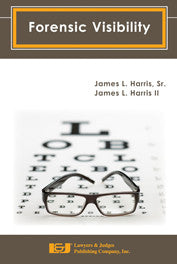
It is important to understand that, unlike a digital camera, we do not store images. What we do place in our memory is our interpretation of what we believe are important details that we derive from our visual sightings. Each time we pull these events from memory and study them, we may refine our interpretations and end up adding detail not present in our original stored memory. Following that mental activity, we will once again store the information in memory and this updated memory will incorporate these new interpretations and details that were not previously recorded. The above paragraph comes from the latest release from Lawyers & Judges Publishing Co., a compact 132-page softcover book titled Forensic Visibility. Written by James L. Harris, Sr., and his late son James L. Harris II, the book covers a diverse number of topics for a variety of readers. It helps explain why witnesses change their stories after giving their initial statement to investigators. The involved person has time to revisit what he originally saw and tweak it into a version he finds more acceptable at least perhaps more in his favor. Anyone who has been doing crash investigations and accident reconstructions for even a short amount of time, know that eye witnesses generally make the worst witnesses and five so-called eye witnesses to an event may easily give you five separate and often quite different accounts of how the event occurred. James Sr. and his son James II, began working on outlines for the book some seven years ago, but in 2009, Senior concentrated on completing the book. He has an extensive background that equipped him. He told me that his early desire to write the book was actually triggered by the experience he had when he first joined the Visibility Laboratory in 1954. As I began to learn about the human visual system, I found myself, time after time, surprised as to visual system capabilities and limitations. I began to realize that from time of birth, I received no training as to how to use my eyes. As a child, I learned from a variety of experiences such as bumping into table legs, etc. I think this is the way it works for most people. The net result is that, as I became an adult, I took my eyesight for granted and had [many] false perceptions about my actual visual performance capabilities and limitations. One of the goals of the Visibility Laboratory was to apply what we learned about the human visual system to real world situations. Mr. Harris has some actual hands-on work investigating collisions as a police officer. He served as a Level 3 Reserve Officer with the San Diego Police Department for 9 years. According to Harris, The Level III program was an attempt to bring on board volunteers with specialized knowledge that might be of use to the Department. After graduation, I took some Police Academy coursework in accident investigation. In many accidents there are important questions related to visibility issues as to whether parties involved should have been able to make visual sightings that would have allowed them to take actions that would have avoided the accident. That brings us to the present and the book itself. Forensic Visibility has only four chapters: 1. The Human Visual System; 2. Forensic Photography; 3. Pedestrian and Automobile Accidents; and 4. Aircraft Accidents. The last chapter may be of only minimal interest to most who read this review mainly because the majority of us rarely, if ever, get to reconstruction or even investigate an aircraft accident. The chapter discusses a wide range of topics from midair collisions to collision avoidance to tower detection, pilot responsibilities and more. The second chapter should interest anyone who takes photographs at crash scenes. The chapter is probably bit too technical for most of us. I mean how often do we enter discussions about The Concept of Linearity or Adjusting the Luminance of the Projected Image? Or, does the equation 100*CS/C = 100*BB/(BB+BS) ring a bell? But technicalities aside, I am sure the conscientious crash reconstructionist will get something useful from the text. Although that first chapter discusses Central Fovea Resolution and Daytime Peripheral Resolution, there are sections to benefit the curious reader. But the third chapter, Pedestrian and Automobile Accidents, is worth the price of the book all by itself. The authors cover The Collision Triangle, Photographic Documentation, Pedestrian Sighting of an Oncoming Vehicle While Making a Mid-Block Crossing, Comparison of Driver and Pedestrian Visual Tasks in Mid-Block Crossings, Intersection Lighting Provided by Streetlights, Trip/Slip and Fall Accidents, Vehicle/Vehicle Accidents, Distance Judgment, Eyewitness Testimony, Importance of Signal Lights, and Unlit Stationary Vehicles at Night, among others. The senior author notes that he is a mathematically oriented engineer and he admits and recognizes that the equations and graphs may not be at all helpful to some reader...