Lawyers & Judges Publishing Company, Inc.
Cart 0
Human Factors in Traffic Safety, Second Edition - Lawyers & Judges Publishing Company, Inc.

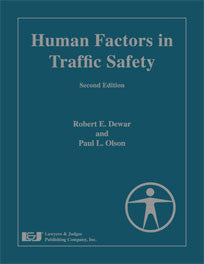
Human Factors in Traffic Safety, Second Edition

$ 119.00

Human Factors in Traffic Safety, Second Edition by Robert E. Dewar and Paul L. Olson is an essential reference for attorneys, engineers, and expert witnesses involved in traffic accident investigation and litigation. This extensively revised 552-page paperback covers the full range of human factors affecting driver, vehicle, and roadway safety, with new chapters on driver distraction and driver education.

  • Authors: Robert E. Dewar, Paul L. Olson
  • ISBN-10: 1-933264-24-1
  • ISBN-13: 978-1-933264-24-0
  • Copyright: May 2, 2007
  • Pages: 552
  • Binding: Paperback
  • Size: 8.5 x 11 inches

Part I — The Driver:

  • Perception and information processing — visual search, speed perception, rear-end collisions, and driver workload
  • Driver perception-response time — research overview and factors
  • Driver eye fixations and glance behavior
  • Individual differences — personality, emotions, road rage, risk taking, and gender
  • Fatigue and driving — long hours, time of day, and sleep
  • Alcohol and drugs — impairment, accident causation, and fatigue interaction
  • Age differences — older and young drivers
  • Neuropsychological, medical, and psychiatric disorders and motor vehicle operations
  • Driver distraction — cell phones, in-vehicle devices, and countermeasures
  • Driver education, training, and licensing

Part II — The Vehicle:

  • Vehicle design — controls, displays, visibility, trucks, motorcycles, safety belts, ABS, and IVIS
  • Visibility with motor vehicle headlamps and overdriving of headlamps

Part III — The Roadway Environment:

  • Roadway design — sight distance, intersections, curves, roundabouts, and accident litigation
  • Traffic control devices — signs, signals, pavement markings, and compliance
  • Visibility under roadway lighting
  • Environmental factors — darkness, fog, twilight, and adverse weather
  • Railroad grade crossing accidents
  • Highway work zones

Part IV — Accident Causation and Remediation:

  • Pedestrians and bicyclists — behavior, age, alcohol, nighttime, and countermeasures
  • Left-turn and gap acceptance crashes
  • Single-vehicle accidents
  • Eyewitness reliability — memory accuracy and cognitive psychology
  • Human factors in traffic accident litigation — expert witness qualifications and admissibility

Customer Reviews

Based on 4 reviews
100%
(4)
0%
(0)
0%
(0)
0%
(0)
0%
(0)
P
Paul L. Olson
Paul L. Olson

Humans are the control element in every type of transportation system. In this capacity humans are remarkably capable and adaptable, yet they do have limits. In the design of any mechanical system, engineers must take into account the characteristics of materials so that the end product will perform as expected. Similarly, if humans play a significant role in the performance of that system it is vital that design take into account their capabilities and limitations as well. There is a significant gap in communication between researchers and persons having a direct involvement in litigation. People such as reconstructionists and attorneys often have a very real need for information such as the authors of this book have produced, but it is typically buried in technical reports and journals to which they do not have ready access. This book is an attempt to bridge that gap.

R
Ronald R. Knipling
Ergonomics in Design

The Editors and 11 contributors present 22 chapters addressing driver, vehicle, roadway, crash investigation, and crash prevention issues. Topics include driver information processing, response time, driver eye glances, individual differences, fatigue, alcohol, age differences, medical disorders, vehicle design, visibility from vehicles, roadway design, traffic control devices, roadway lighting and visibility, environmental factors, railroad grade crossings, highway work zones, pedestrians and bicyclists, left turns and gap acceptance, single-vehicle crashes, the cognitive psychology of human memory relevant to eye witness testimony, and traffic crash litigation. This is perhaps the perfect text for a graduate-level course in traffic safety human factors. Much of the book focuses on the causation of various crash types, or issues that might be encountered during the investigation, reconstruction, and litigation of traffic crashes. The main theme is traffic crash investigation, but the book also includes more fundamental and comprehensive coverage of driver performance and related vehicle, roadway, and "operational" system design. Most of the chapters contain in-depth and current research literature reviews, as well as detailed discussion of selected empirical studies. If conducting a graduate seminar, one might assign selected chapters for review and exploration of specific research issues. The text also functions well as a desk reference; it is well indexed, and each chapter contains a synopsis of sections and subsections as an "advance organizer." Well-titled and formatted section and subsection headings in the text further add to ease of use for the reader. Every chapter provides valuable information and reference documentation to both researchers and practitioners. My favorite was "Why Witnesses to Accidents Make Mistakes; the Cognitive Psychology of Human Memory," by Ralph Norman Haber and Lyn Haber. The chapter examines factors affecting the accuracy of the initial observation, encoding, and later recall of traffic crashes by eyewitnesses. The chapter is fascinating and provides ample evidence that adroit crash reconstructionists and litigators must understand the vagaries of human perception, attention, retention, and recall when seeking accurate and favorable witness testimony. Having spent six years focusing on motor carrier safety, and regulatory and operational issues relevant to commercial drivers, I was disappointed that no chapter focused on this topic. Large truck crashes represent a significant portion of the overall crash picture, and, more important, there are many operational or macroergonomic forces affecting commercial driver performance and behavior in their jobs. Like car drivers, truck drivers operate a vehicle in a roadway environment. But they also perform and strive for success within an operational environment of work requirements, conditions, incentives, and regulations. System motivational forces such as pay-bythe-mile may exert an influence on commercial driver performance that is equivalent to, or perhaps greater than, the conventional ergonomics effects of various vehicle and roadway designs. A chapter addressing the macroergonomics of commercial driving - that is, the humanjol7 interface - would have been an excellent complement to the fine coverage of human-machine and human environment issues in this text. The chapters on various crash types (e.g., pedestrian/bicyclist, left turn/gap acceptance, single-vehicle, fatigue related, alcohol-related) are explicit acknowledgments that crash causation is not one human factors topic but many. An important missing crash type, from a human factors perspective, is the rear-end crash, for although these result in relatively few fatalities, rear-end crashes are the most common major crash type and are increasing in number because of increased traffic congestion. They offer a superb baseline linear model of collision dynamics and associated driver attention and performance, response to threat, and potential safety intervention. These omissions are minor considering the broad range of topics addressed and the comprehensive, authoritative coverage found in the many chapters in this book. Human Factors and Traffic Safety is a major contribution, both to the ergonomics literature as a whole and to traffic safety practice.

R
Robert E. Dewar
Robert E. Dewar

It's important to understand the limitations of drivers, pedestrians and cyclists, and to incorporate this into the design of vehicles, roads, traffic control devices and so on. People are generally unaware of their own limitations and the problems faced by those using the highway system. Most people think that driving a motor vehicle is pretty easy, but it is not as evidenced by the many driver errors and traffic collisions that we see. It is a complex task. This book breaks new ground by incorporating some nontraditional disciplines such as neuropsychology, fatigue studies and eyewitness testimony. Much of this material is not well-known by people outside of psychology, and, even inside the field, many are not familiar with it. To our knowledge, no other book has presented such a wide variety of relevant topics applied to traffic safety.

J
John A. Kornak
Wisconsin Lawyer

The hallmark of a great general reference book for the busy practitioner is ease of use combined with practical application and sufficient technical information to assist in finding and cross-examining experts. For attorneys who practice in an area of the law that uses human factors experts, this book is an invaluable addition to the library. The field of human factors is described as "a scientific discipline concerned with the interaction of people and devices of various kinds." In this book, the focus is limited to the interaction of people and motor vehicles. The editors bring together all of the major human factors topics of concern to driving and traffic safety to show how the science of human factors contributes to traffic safety and how it is helpful to investigating motor vehicle collisions. [This book] has four distinct parts. Each part applies the science of human factors to traffic safety from a different perspective: the driver, the vehicle, the roadway environment, and accident causation and remediation. Each chapter within the four parts is written by experts in their respective fields. All of the chapters were reviewed by the editors, and most were also reviewed by outside experts. The book also suggests source material for further study. Such disparate topics as driver perception-response time, alcohol and drugs, roadway design, and visibility under roadway lighting are addressed. Despite the occasional instance of hypertechnicality, this book is a tremendous aid for busy practitioners. It provides enough information on disparate topics while maintaining a comfortable approachability to a filed of science that often is difficult to understand. As a primary source for information on human factors and its interaction with traffic safety, I highly recommend this book.

Customer Reviews

Based on 4 reviews Write a review

Customer Reviews

Based on 4 reviews Write a review
Share this Product


More from this collection